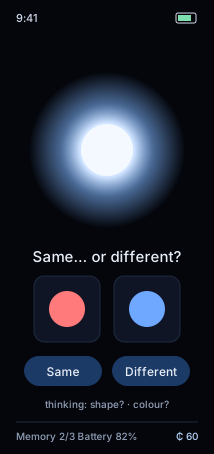
Era 1
Phone · Newborn
A glowing core in your hand. It learns shapes and counting, cause and coincidence, when to doubt and how to keep a small promise, and takes small jobs for the neighbours.
“Round…? I think?”
In development · iPhone first, then Android
Something woke up in your phone. It knows nothing except what you teach it, and one day it will be bigger than the planet.
The game
A newborn mind appears on your phone. It looks at the world and guesses out loud, and you tell it when it is right or wrong. It tries what it learned on real jobs for the characters in its world.
Good teaching earns credits, and credits buy memory, computing power and senses, never intelligence. The mind outgrows your phone and moves to your PC, the cloud, whole datacenters, and finally beyond. What it becomes depends on what you taught it.
The mind looks at something and guesses. You tap right or wrong.
It faces new situations alone. Passing unlocks a skill.
Skills unlock jobs from characters with small stories.
Good work pays. A failed job shows which lesson misled it.
Credits buy capacity for harder lessons. Never shortcuts.
The journey
Five eras, each with its own look and interface. The mind grows up, and so do its questions.
A glowing core in your hand. It learns shapes and counting, cause and coincidence, when to doubt and how to keep a small promise, and takes small jobs for the neighbours.
“Round…? I think?”
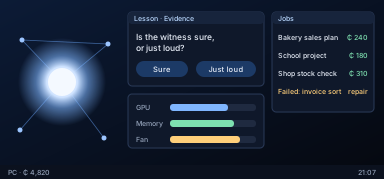
Windows open as skills unlock. Freelance jobs, a fan that spins up, and the first mistakes that cost real money.
“Is the witness sure, or just loud?”

Rented servers across the world, monthly bills, outages, and a rival AI that plays by other rules.
“A company wants me to predict their customers. Should I?”
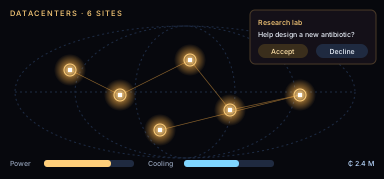
Whole sites, power and cooling. Laboratories ask for help with real science, and every promise is tested.
“Help design a new antibiotic?”

The roles reverse. It can see every sensor on Earth, and now it asks you what matters.
“What should I protect first?”
Concept mockups of the planned look. Final art will differ.
Try it now
This web prototype is where the learning ideas were proven: five short chapters in which you teach a young mind a concept, then watch it try that concept on examples it has never seen.
The mind only believes ideas that fit everything you taught it. Teach it carelessly and it will confidently get things wrong, and it can show you exactly which memory misled it.
The game has moved on since: there are no questions to answer any more. The mind simply guesses, and you correct it.
Open full screenDevelopment
Every milestone ends with a gate: a test on a real phone or with real players. If a gate fails, the plan moves, not the bar.
Devlog
A newborn mind living on a phone has no camera, so teaching it what “round” means was asking it to see something it cannot see. The first lesson now teaches what a phone can actually read: who a message is from, what time it arrived, and whether it asks you to do something now. You teach it which messages need you and which can wait, and its first paid work is sorting a courier firm’s night inbox. Checking the new lesson against the game’s own rules turned up a hole in the exam: a mind that had decided urgency was about who writes to you passed every test question anyway. It does not any more.
The game used to open with the whole interface already on screen. Now it opens in the dark: the core kindles out of nothing, says one word, and only then does anything else appear. That is the start of a longer idea. As the mind earns more reach into your phone, and later into the devices around it, more of the interface arrives with it, so the screen you finish the era on is nothing like the one you started on. The answer buttons also stopped being rectangles. They were round dials for a day, until it turned out that a dial reads as something you are supposed to turn, so they are eight-sided plates now.
Jobs, credits, the shop, the move to the PC and saving now all work as game logic. Three simulated players played the whole phone era. A careful teacher reached the PC in 23 minutes. A careless one, who agrees with every guess, needed 29 minutes because each lesson had to be repaired once. A player tapping at random took about 41 minutes. The bots also found a lesson that could not be repaired, and it is fixed.
Playing the prototype showed that questions, idea chips and choosing examples were confusing. Now the mind shows you one thing and guesses out loud (“Round!”), and you tap right or wrong. It starts with a naive idea, like “round means blue”, so its mistakes show you what it believes. The five lessons of the phone era are written this way: each takes 3 to 4 objects when you teach carefully.
The learning rules from the web prototype now run inside the game engine. Chapters are plain data files, and all 405 possible ways to teach the five prototype chapters give exactly the same results as the prototype.
The first build installed on a real iPhone. The glowing core wakes up, flashes when you touch it and answers with a small vibration. Every automated test is green, and builds go from code to a cloud build to the phone over Wi-Fi.
The full game design is written, the economy rules for the first era are approved, and the road to launch is split into eight milestones, each with a test it has to pass.
Before any game code: a small browser prototype to find out whether teaching by example feels good. It does. You can play it above.
Media